Harnessing Data Science and Artificial Intelligence to:
Eliminate barriers that prevent institutions from performing meaningful strategic analysis
Manage growing expectations among stakeholders and institutional leadership
Prioritize consistent data governance and management principles
Part 2 · Data Science & AI Intersection
FAIR Principles as Operational Guardrails
Use persistent identifiers and searchable metadata.
Provide clear retrieval pathways with governed permissions.
Adopt shared formats and vocabularies across systems.
Document provenance, context, and usage constraints.
FAIR source: Wilkinson, M. D., et al. (2016).
“The FAIR Guiding Principles for scientific data management and stewardship.”
Scientific Data, 3, 160018.
Graphic: Cloud-SPAN.
Part 2 · Data Science & AI Intersection
The Intersection of Data Science and Artificial Intelligence
Shift 1
Proactive Data Science
A Shift in Our Reach
🛠️
Agentic coding and development tools make building new systems attainable in a short period of time.
📊
Traditional data science backgrounds are well-aligned with advances in artificial intelligence.
🧠
Endless opportunities and development trees can lead to “Brain Fry.”
Brain Fry citation: Harvard Business Review. (March 2026). “When Using AI Leads to Brain Fry.”
Part 2 · Data Science & AI Intersection
The Intersection of Data Science and Artificial Intelligence
Shift 2
Reactive Data Science
A Shift in Stakeholder Values
⚡
Stakeholders now expect faster, more effective solutions powered by AI.
🏁
Perceived competition and fear of getting left behind drives initiatives.
💬
Less appeal to dashboards, more appeal to chatbot interfaces.
Part 2 · Data Science & AI Intersection
Build a sentence one token at a time
Click the next word. Each choice shifts what comes next, just like an LLM.
No right answer, only probabilities. This is why LLMs produce different output each time.
Part 2 · Data Science & AI Intersection
Simplify the Approach
Step 1
Identify a black hole
Spot well-defined tasks that are creating unnecessarily large bottlenecks.
→
Step 2
Classify the task
Can data science or artificial intelligence be used to automate or collaborate?
→
Step 3
Build a simple solution
The solution must be less intimidating and complex than the original task.
Part 3 · Sandbox Time
Stepping Into the Vandalizer
Jump straight into the University of Idaho’s AI prompt workspace.
US Copyright Office: AI-generated content without significant human authorship is not copyrightable
“Meaningful human contribution” is the standard — but the line is still being drawn
If AI writes your proposal narrative and you submit it unchanged, you may not own it
Training data raises separate IP questions: models learn from copyrighted material, but the legal landscape is unsettled
For research administrators
AI-assisted drafts need substantial human editing to establish authorship
AI-generated figures and data visualizations are especially murky
Institutional IP policies may not yet address AI — flag this gap
Sponsor terms of award may add additional constraints
Part 4 · Decision Frameworks
Research Analytic Accountability
AI has no integrity, no professional ethics, no accountability. Someone with professional judgment must always own the final call.
“A computer can never be held accountable; therefore a computer must never make a management decision.” — IBM, 1979
Policy interpretation and institutional context
Compliance determinations
Ethical judgment and risk assessment
Decisions that require accountability
Part 4 · Decision Frameworks
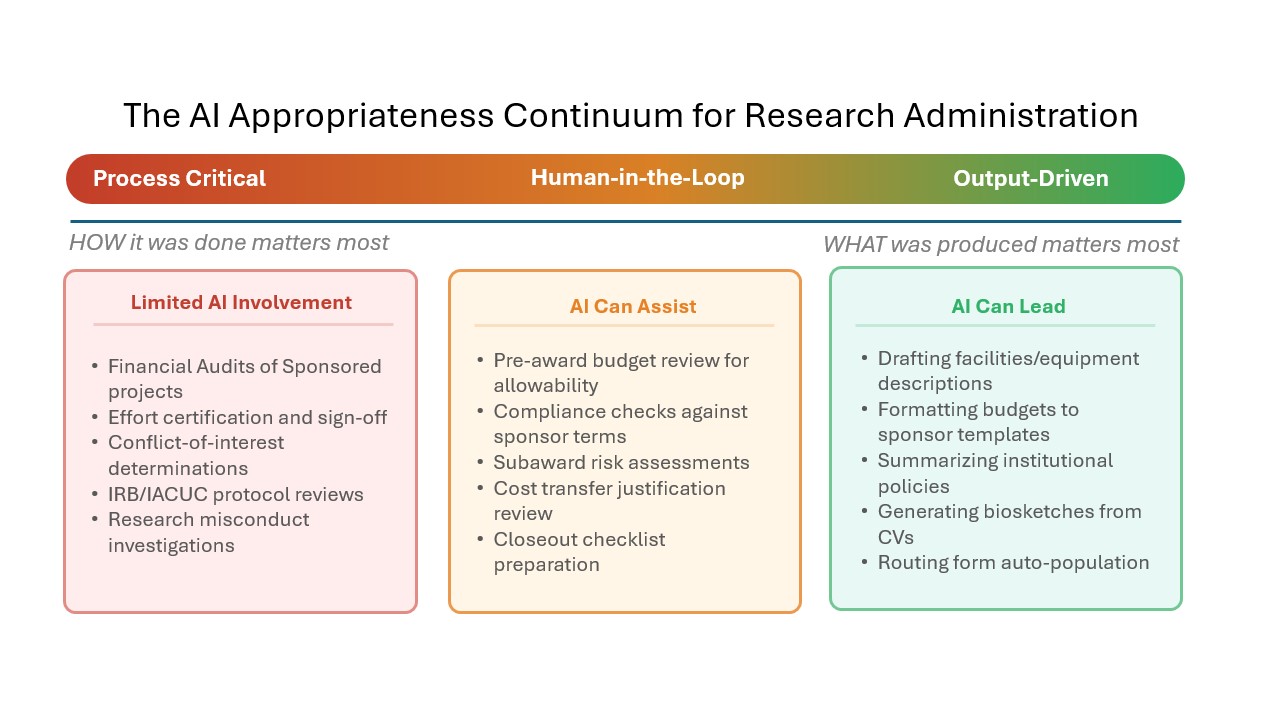
Does it matter how the work got done?
Human leads — Every step must be auditable. AI may assist, but a human owns the reasoning.
Human in the loop — AI prepares, a qualified person reviews and decides.
AI leads — Only the result matters. AI can lead; validate with spot-checks.
Part 4 · Decision Frameworks
Classify these analytic tasks
Drag each slider. What do you think?
Faculty Workload Modeling
ROI Analysis
Financial Projections
Compliance Cycle-Time
Impact Reporting
Competition Intelligence Dashboards
Human LeadsHuman in the LoopAI Leads
Part 4 · Decision Frameworks
Data Science Tasks vs. AI Tasks: Then and Now
BEFORE
Careful distinction between tasks that are well-suited for “data science work” or “AI work.”
→
AFTER
Agentic workflows call specialized tools that are tailored to the target task
TRUE PRINCIPLE
Task fit matters for optimized results from artificial intelligence
Part 4 · Decision Frameworks
From Prompt Engineering to Intent Engineering
BEFORE
Significant emphasis placed on crafting effective prompts to optimize the output
→
AFTER
Better processes reduce the need for perfecting prompts with large, mainstream models
TRUE PRINCIPLE
Prompt design helps users get output that aligns with their intent
Part 4 · Decision Frameworks
Four disciplines for AI interaction
Your AI has a page limit — the context window
10%Intent
50%Information
25%Instructions
15%Conversation
Intent
Telosa
Information
Mnemos
Instructions
Promptulus
Conversation
Dialogos
Every AI model has a context window — a fixed limit on how much it can read at once. All four disciplines compete for that space. Getting the balance right is the skill.